mercredi 27 février 2013

Religion, folklore and culture of bird


Religion, folklore and culture of bird

 Woodcut of three long-legged and long-necked birds
"The 3 of Birds" by the Master of
the Playing Cards, 15th century Germany
Birds play prominent and diverse roles in folklore, religion, and popular culture. In religion, birds may serve as either messengers or priests and leaders for a deity, such as in the Cult of Makemake, in which the Tangata manu of Easter Islandserved as chiefs;or as the rooster(cock) serves as a tangible vessel of Christ as in the gospel of –Matthew, Mark and Luke in the New Testament with Christ speaking through the cock; or as attendants, as in the case of Hugin and Munin, two Common Ravens who whispered news into the ears of the Norse god Odin.In several civilizations of ancient Italy, particularly Etruscan and Roman religion, priests were involved in augury, or interpreting the words of birds while the "auspex" (from which the word "auspicious" is derived) watched their activities to foretell events. They may also serve as religious symbols, as when Jonah (Hebrew:יוֹנָה, dove) embodied the fright, passivity, mourning, and beauty traditionally associated with doves. Birds have themselves been deified, as in the case of the Common Peacock, which is perceived as Mother Earth by the Dravidians of India.Some birds have also been perceived as monsters, including the mythological Roc and the Māori's legendary Pouākai, a giant bird capable of snatching humans.


A singing bird box, an example of the interest of human beings in birds, emulating nature with a mechanical version for joy and entertaining.
Birds have been featured in culture and art since prehistoric times, when they were represented in early cave paintings.Birds were later used in religious or symbolic art and design, such as the magnificent Peacock Throne of the Mughal andPersian emperors. With the advent of scientific interest in birds, many paintings of birds were commissioned for books. Among the most famous of these bird artists was John James Audubon, whose paintings of North American birds were a great commercial success in Europe and who later lent his name to the National Audubon Society. Birds are also important figures in poetry; for example, Homer incorporated Nightingales into his Odyssey, and Catullus used a sparrow as an erotic symbol in his Catullus 2.The relationship between an albatross and a sailor is the central theme of Samuel Taylor Coleridge's The Rime of the Ancient Mariner, which led to the use of the term as a metaphor for a 'burden'. Other Englishmetaphors derive from birds; vulture funds and vulture investors, for instance, take their name from the scavenging vulture.
Perceptions of various bird species often vary across cultures. Owls are associated with bad luck, witchcraft, and death in parts of Africa,but are regarded as wise across much of Europe.Hoopoes were considered sacred in Ancient Egypt and symbols of virtue in Persia, but were thought of as thieves across much of Europe and harbingers of war in Scandinavia.

Economic importance of bird


Economic importance of bird
Domesticated birds raised for meat and eggs, called poultry, are the largest source of animal protein eaten by humans; in 2003, 76 million tons of poultry and 61 million tons of eggs were produced worldwide.[Chickens account for much of human poultry consumption, though turkeys, ducks, and geese are also relatively common. Many species of birds are also hunted for meat. Bird hunting is primarily a recreational activity except in extremely undeveloped areas. The most important birds hunted in North and South America are waterfowl; other widely hunted birds include pheasants, wild turkeys, quail, doves, partridge, grouse, snipe, and woodcock. Muttonbirding is also popular in Australia and New Zealand. Though some hunting, such as that of muttonbirds, may be sustainable, hunting has led to the extinction or endangerment of dozens of species.


The use of cormorants by Asian fishermen is in steep decline but survives in some areas as a tourist attraction.
Other commercially valuable products from birds include feathers (especially the down of geese and ducks), which are used as insulation in clothing and bedding, and seabird feces (guano), which is a valuable source of phosphorus and nitrogen. The War of the Pacific, sometimes called the Guano War, was fought in part over the control of guano deposits.
Birds have been domesticated by humans both as pets and for practical purposes. Colourful birds, such as parrots and mynas, are bred in captivity or kept as pets, a practice that has led to the illegal trafficking of some endangered species.Falcons and cormorants have long been used for hunting and fishing, respectively. Messenger pigeons, used since at least 1 AD, remained important as recently as World War II. Today, such activities are more common either as hobbies, for entertainment and tourism,or for sports such as pigeon racing.

Amateur bird enthusiasts (called birdwatchers, twitchers or, more commonly, birders) number in the millions.Many homeowners erect bird feeders near their homes to attract various species. Bird feeding has grown into a multimillion dollar industry; for example, an estimated 75% of households in Britain provide food for birds at some point during the winter.

Relationship with humans


Relationship with humans


 Two rows of cages in a dark barn with many white chickens in each cageSince birds are highly visible and common animals, humans have had a relationship with them since the dawn of man.Sometimes, these relationships are mutualistic, like the cooperative honey-gathering among honeyguides and African peoples such as the Borana. Other times, they may be commensal, as when species such as the House Sparrow have benefited from human activities. Several bird species have become commercially significant agricultural pests, and some pose an aviation hazard.Human activities can also be detrimental, and have threatened numerous bird species with extinction (hunting, avian lead poisoning, pesticides, roadkill, and predation by pet cats and dogs are common sources of death for birds).
 Illustration of fisherman on raft with pole for punting and numerous black birds on raftBirds can act as vectors for spreading diseases such as psittacosis, salmonellosis, campylobacteriosis, mycobacteriosis (avian tuberculosis), avian influenza (bird flu), giardiasis, and cryptosporidiosis over long distances. Some of these are zoonotic diseases that can also be transmitted to humans.

Ecology of bird


Ecology of bird


Birds occupy a wide range of ecological positions.While some birds are generalists, others are highly specialised in their habitat or food requirements. Even within a single habitat, such as a forest, the niches occupied by different species of birds vary, with some species feeding in the forest canopy, others beneath the canopy, and still others on the forest floor. Forest birds may be insectivores, frugivores, and nectarivores. Aquatic birds generally feed by fishing, plant eating, and piracy or kleptoparasitism. Birds of prey specialise in hunting mammals or other birds, while vultures are specialised scavengers. Avivores are animals that are specialized at predating birds.
 Two rows of cages in a dark barn with many white chickens in each cage
                                Industrial farming of chickens

Some nectar-feeding birds are important pollinators, and many frugivores play a key role in seed dispersal. Plants and pollinating birds often coevolve,and in some cases a flower's primary pollinator is the only species capable of reaching its nectar.

Birds are often important to island ecology. Birds have frequently reached islands that mammals have not; on those islands, birds may fulfill ecological roles typically played by larger animals. For example, in New Zealand the moas were important browsers, as are the Kereru and Kokako today.

Today the plants of New Zealand retain the defensive adaptations evolved to protect them from the extinct moa. Nesting seabirds may also affect the ecology of islands and surrounding seas, principally through the concentration of large quantities of guano, which may enrich the local soil and the surrounding seas.
A wide variety of Avian ecology field methods, including counts, nest monitoring, and capturing and marking, are used for researching avian ecology.

Brood parasites of bird


Brood parasites of bird

 Small brown bird places an insect in the bill of much larger grey bird in nest
Reed Warbler raising a
Common Cuckoo, a brood parasite
Brood parasitism, in which an egg-layer leaves her eggs with another individual's brood, is more common among birds than any other type of organism. After a parasitic bird lays her eggs in another bird's nest, they are often accepted and raised by the host at the expense of the host's own brood. Brood parasites may be either obligate brood parasites, which must lay their eggs in the nests of other species because they are incapable of raising their own young, or non-obligate brood parasites, which sometimes lay eggs in the nests of conspecifics to increase their reproductive output even though they could have raised their own young. One hundred bird species, including honeyguides, icterids, estrildid finches and ducks, are obligate parasites, though the most famous are thecuckoos.Some brood parasites are adapted to hatch before their host's young, which allows them to destroy the host's eggs by pushing them out of the nest or to kill the host's chicks; this ensures that all food brought to the nest will be fed to the parasitic chicks.

Territories, nesting and incubation of Bird nest


Territories, nesting and incubation of Bird nest


Many birds actively defend a territory from others of the same species during the breeding season; maintenance of territories protects the food source for their chicks. Species that are unable to defend feeding territories, such as seabirds and swifts, often breed in colonies instead; this is thought to offer protection from predators. Colonial breeders defend small nesting sites, and competition between and within species for nesting sites can be intense.
All birds lay amniotic eggs with hard shells made mostly of calcium carbonate. Hole and burrow nesting species tend to lay white or pale eggs, while open nesters lay camouflaged eggs. There are many exceptions to this pattern, however; the ground-nesting nightjars have pale eggs, and camouflage is instead provided by their plumage. Species that are victims of brood parasites have varying egg colours to improve the chances of spotting a parasite's egg, which forces female parasites to match their eggs to those of their hosts.

 Yellow weaver (bird) with black head hangs an upside-down nest woven out of grass fronds.
Male Golden-backed Weavers construct
 elaborate suspended nests out of grass
Bird eggs are usually laid in a nest. Most species create somewhat elaborate nests, which can be cups, domes, plates, beds scrapes, mounds, or burrows.Some bird nests, however, are extremely primitive; albatross nests are no more than a scrape on the ground. Most birds build nests in sheltered, hidden areas to avoid predation, but large or colonial birds—which are more capable of defence—may build more open nests. During nest construction, some species seek out plant matter from plants with parasite-reducing toxins to improve chick survival, and feathers are often used for nest insulation.Some bird species have no nests; the cliff-nesting Common Guillemot lays its eggs on bare rock, and male Emperor Penguins keep eggs between their body and feet. The absence of nests is especially prevalent in ground-nesting species where the newly hatched young are precocial.
 Nest made of straw with five white eggs and one grey speckled egg
Nest of an Eastern Phoebe
that has been parasitised 
Incubation, which optimises temperature for chick development, usually begins after the last egg has been laid.In monogamous species incubation duties are often shared, whereas in polygamous species one parent is wholly responsible for incubation. Warmth from parents passes to the eggs through brood patches, areas of bare skin on the abdomen or breast of the incubating birds. Incubation can be an energetically demanding process; adult albatrosses, for instance, lose as much as 83 grams (2.9 oz) of body weight per day of incubation. The warmth for the incubation of the eggs of megapodes comes from the sun, decaying vegetation or volcanic sources.[159]Incubation periods range from 10 days (in woodpeckers, cuckoos and passerine birds) to over 80 days (in albatrosses and kiwis).

Parental care and fledging

At the time of their hatching, chicks range in development from helpless to independent, depending on their species. Helpless chicks are termedaltricial, and tend to be born small, blind, immobile and naked; chicks that are mobile and feathered upon hatching are termed precocial. Altricial chicks need help thermoregulating and must be brooded for longer than precocial chicks. Chicks at neither of these extremes can be semi-precocial or semi-altricial.

 Hummingbird perched on edge of tiny nest places food into mouth of one of two chicks

A female Calliope Hummingbird feeding fully grown chicks
The length and nature of parental care varies widely amongst different orders and species. At one extreme, parental care in megapodes ends at hatching; the newly hatched chick digs itself out of the nest mound without parental assistance and can fend for itself immediately.At the other extreme, many seabirds have extended periods of parental care, the longest being that of the Great Frigatebird, whose chicks take up to six months to fledge and are fed by the parents for up to an additional 14 months. The chick guard stage describes the period of breeding during which one of the adult birds is permanently present at the nest after chicks have hatched. The main purpose of the guard stage is to aid offspring to thermoregulate and protect them from predation.
In some species, both parents care for nestlings and fledglings; in others, such care is the responsibility of only one sex. In some species, other members of the same species—usually close relatives of the breeding pair, such as offspring from previous broods—will help with the raising of the young. Such alloparenting is particularly common among the Corvida, which includes such birds as the true crows, Australian Magpie and Fairy-wrens,but has been observed in species as different as the Rifleman and Red Kite. Among most groups of animals, male parental care is rare. In birds, however, it is quite common—more so than in any other vertebrate class. Though territory and nest site defence, incubation, and chick feeding are often shared tasks, there is sometimes a division of labour in which one mate undertakes all or most of a particular duty.
Looking down on three helpless blind chicks in a nest within the hollow of a dead tree trunk
Altricial chicks of a White-breasted Woodswallow
The point at which chicks fledge varies dramatically. The chicks of the Synthliboramphus murrelets, like the Ancient Murrelet, leave the nest the night after they hatch, following their parents out to sea, where they are raised away from terrestrial predators.
Some other species, such as ducks, move their chicks away from the nest at an early age. In most species, chicks leave the nest just before, or soon after, they are able to fly. The amount of parental care after fledging varies; albatross chicks leave the nest on their own and receive no further help, while other species continue some supplementary feeding after fledging. Chicks may also follow their parents during their first migration.

Social systems of bird


Social systems of bird


Ninety-five percent of bird species are socially monogamous. These species pair for at least the length of the breeding season or—in some cases—for several years or until the death of one mate.Monogamy allows for biparental care, which is especially important for species in which females require males' assistance for successful brood-rearing. Among many socially monogamous species, extra-pair copulation (infidelity) is common.Such behaviour typically occurs between dominant males and females paired with subordinate males, but may also be the result of forced copulation in ducks and other anatids. For females, possible benefits of extra-pair copulation include getting better genes for her offspring and insuring against the possibility of infertility in her mate.Males of species that engage in extra-pair copulations will closely guard their mates to ensure the parentage of the offspring that they raise.
File:Raggiana Bird-of-Paradise wild 5.jpg
Like others of its family the male Raggiana Bird of Paradise
has elaborate breeding plumage used to impress females.

Other mating systems, including polygyny, polyandry, polygamy, polygynandry, and promiscuity, also occur.Polygamous breeding systems arise when females are able to raise broods without the help of males.Some species may use more than one system depending on the circumstances.
Breeding usually involves some form of courtship display, typically performed by the male. Most displays are rather simple and involve some type of song. Some displays, however, are quite elaborate. Depending on the species, these may include wing or tail drumming, dancing, aerial flights, or communal lekking. Females are generally the ones that drive partner selection,although in the polyandrous phalaropes, this is reversed: plainer males choose brightly coloured females.Courtship feeding, billing and allopreening are commonly performed between partners, generally after the birds have paired and mated.

Homosexual behaviour has been observed in males or females in numerous species of birds, including copulation, pair-bonding, and joint parenting of chicks.

Resting and roosting of bird


Resting and roosting of bird


The high metabolic rates of birds during the active part of the day is supplemented by rest at other times. Sleeping birds often use a type of sleep known as vigilant sleep, where periods of rest are interspersed with quick eye-opening "peeks", allowing them to be sensitive to disturbances and enable rapid escape from threats.Swifts are believed to be able to sleep in flight and radar observations suggest that they orient themselves to face the wind in their roosting flight. It has been suggested that there may be certain kinds of sleep which are possible even when in flight. Some birds have also demonstrated the capacity to fall into slow-wave sleep one hemisphere of the brain at a time. The birds tend to exercise this ability depending upon its position relative to the outside of the flock. This may allow the eye opposite the sleeping hemisphere to remain vigilant for predators by viewing the outer margins of the flock. This adaptation is also known from marine mammals. Communal roosting is common because it lowers the loss of body heat and decreases the risks associated with predators. Roosting sites are often chosen with regard to thermoregulation and safety.

 Pink flamingo with grey legs and long neck pressed against body and head tucked under wings
                                   Many birds, like this American Flamingo,
                                          tuck their head into their back when sleeping
Many sleeping birds bend their heads over their backs and tuck their bills in their back feathers, although others place their beaks among their breast feathers. Many birds rest on one leg, while some may pull up their legs into their feathers, especially in cold weather. Perching birds have a tendon locking mechanism that helps them hold on to the perch when they are asleep. Many ground birds, such as quails and pheasants, roost in trees. A few parrots of the genus Loriculus roost hanging upside down. Some hummingbirds go into a nightly state of torpor accompanied with a reduction of their metabolic rates.This physiological adaptation shows in nearly a hundred other species, including owlet-nightjars, nightjars, and woodswallows.
 One species, the Common Poorwill, even enters a state of hibernation.Birds do not have sweat glands, but they may cool themselves by moving to shade, standing in water, panting, increasing their surface area, fluttering their throat or by using special behaviours like urohidrosis to cool themselves.

Flocking and other associations of bird


Flocking and other associations of bird
While some birds are essentially territorial or live in small family groups, other birds may form large flocks. The principal benefits of flocking are safety in numbers and increased foraging efficiency.


File:Red-billed quelea flocking at waterhole.jpg
Red-billed Queleas, the most numerous species of bird,form enormous flocks—sometimes tens of thousands strong.

 Defence against predators is particularly important in closed habitats like forests, where ambush predation is common and multiple eyes can provide a valuable early warning system. This has led to the development of many mixed-species feeding flocks, which are usually composed of small numbers of many species; these flocks provide safety in numbers but increase potential competition for resources.
Costs of flocking include bullying of socially subordinate birds by more dominant birds and the reduction of feeding efficiency in certain cases.
Birds sometimes also form associations with non-avian species. Plunge-diving seabirds associate with dolphins and tuna, which push shoaling fish towards the surface.Hornbills have a mutualistic relationship with Dwarf Mongooses, in which they forage together and warn each other of nearby birds of prey and other predators.

Bird vocalization


 Bird vocalization

Birds communicate using primarily visual and auditory signals. Signals can be interspecific (between species) and intraspecific (within species).
Birds sometimes use plumage to assess and assert social dominance, to display breeding condition in sexually selected species, or to make threatening displays, as in the Sunbittern's mimicry of a large predator to ward off hawks and protect young chicks.Variation in plumage also allows for the identification of birds, particularly between species. Visual communication among birds may also involve ritualised displays, which have developed from non-signalling actions such as preening, the adjustments of feather position, pecking, or other behaviour. These displays may signal aggression or submission or may contribute to the formation of pair-bonds.The most elaborate displays occur during courtship, where "dances" are often formed from complex combinations of many possible component movements;males' breeding success may depend on the quality of such displays.

File:Red-billed quelea flocking at waterhole.jpg
Red-billed Queleas, the most numerous species of bird,
form enormous flocks—sometimes tens of thousands strong.
Bird calls and songs, which are produced in the syrinx, are the major means by which birds communicate with sound. This communication can be very complex; some species can operate the two sides of the syrinx independently, allowing the simultaneous production of two different songs.Calls are used for a variety of purposes, including mate attraction, evaluation of potential mates, bond formation, the claiming and maintenance of territories,the identification of other individuals (such as when parents look for chicks in colonies or when mates reunite at the start of breeding season),and the warning of other birds of potential predators, sometimes with specific information about the nature of the threat.Some birds also use mechanical sounds for auditory communication. The Coenocorypha snipes of New Zealand drive air through their feathers,woodpeckers drum territorially, and Palm Cockatoos use tools to drum.

Behaviour of bird


Behaviour of bird

Most birds are diurnal, but some birds, such as many species of owls and nightjars, are nocturnal or crepuscular (active during twilight hours), and many coastal waders feed when the tides are appropriate, by day or night.


A pet Congo African Grey Parrot displaying signs
 of extensive feather-plucking.

When analyzing the behaviour of birds in captivity, what is considered normal or abnormal behaviour is dependent on the form and frequency that the particular behaviour is expressed in the natural environment.

Birds raised in pet stores tend to be raised with other birds, however, after being sold and taken to the owner's home, birds in captivity are often housed in isolation and in environments lacking abundant resources orcomplex stimuli. In the United States, it is estimated that forty million birds are kept caged and improperly cared for.Because of these inappropriate housing conditions, abnormal behaviour patterns may appear in caged birds kept as pets. Once established, thess abnormal behaviours in birds are often not alterable.


When social interactions amongst birds are absent or inadequate, abnormal social behaviour may develop. For example, a study regarding parrots that had been isolated in cages demonstrated that most birds showing this social deprivation had significant behavioural disturbances, such as aggressive behaviour, feather picking, self-mutilation, restlessness, screaming, apathetic behavior, and stereotypies.Cannibalism often occurs in large animal husbandry systems, which are usually impoverished environments with a lack of opportunities. In addition, studies of caged canaries have revealed two common stereotypies. These include spot picking, where birds repeatedly touch a particular spot in the environment with the tip of their beak, and route tracing, a pacing behaviour associated with physical restrictions in movement imposed by the cage.

The absence of song learning in zebra finches has also been implicated as a behavioural abnormality. In these birds, the social interaction of a young male with his song tutor is important for normal song development. Without the stimulus, the song, which is necessary for mating behavior, will not be learned.
Researchers have analyzed ways to alleviate some abnormal behaviours in caged birds. Presenting these birds with novel stimuli e.g. a mirror or plastic birds, and social stimuli, such as a brief view of a bird in another cage, significantly reduced stereotypies.In addition, it has been suggested that keeping caged birds in pairs or small groups may reduce the development of abnormal behaviours, however, little quantitative evidence has thus far been collected to support this claim.

Diet and feeding of bird


Diet and feeding of bird


File:BirdBeaksA.svg
Feeding adaptations in beaks
Birds' diets are varied and often include nectar, fruit, plants, seeds, carrion, and various small animals, including other birds. Because birds have no teeth, their digestive system is adapted to process unmasticated food items that are swallowed whole.

Birds that employ many strategies to obtain food or feed on a variety of food items are called generalists, while others that concentrate time and effort on specific food items or have a single strategy to obtain food are considered specialists.Birds' feeding strategies vary by species. Many birds glean for insects, invertebrates, fruit, or seeds. Some hunt insects by suddenly attacking from a branch. Those species that seek pest insects are considered beneficial 'biological control agents' and their presence encouraged in biological pest control programs. Nectar feeders such as hummingbirds, sunbirds, lories, and lorikeets amongst others have specially adapted brushy tongues and in many cases bills designed to fit co-adapted flowers.Kiwis and shorebirds with long bills probe for invertebrates; shorebirds' varied bill lengths and feeding methods result in the separation of ecological niches.Loons, diving ducks, penguins and auks pursue their prey underwater, using their wings or feet for propulsion,while aerial predators such as sulids, kingfishers and terns plunge dive after their prey. Flamingos, three species of prion, and some ducks are filter feeders.Geese and dabbling ducks are primarily grazers.

Some species, including frigatebirds, gulls,nd skuas, engage in kleptoparasitism, stealing food items from other birds. Kleptoparasitism is thought to be a supplement to food obtained by hunting, rather than a significant part of any species' diet; a study of Great Frigatebirds stealing from Masked Boobies estimated that the frigatebirds stole at most 40% of their food and on average stole only 5%.[96] Other birds are scavengers; some of these, like vultures, are specialised carrion eaters, while others, like gulls, corvids, or other birds of prey, are opportunists.


Water and drinking
Water is needed by many birds although their mode of excretion and lack of sweat glands reduces the physiological demands.Some desert birds can obtain their water needs entirely from moisture in their food. They may also have other adaptations such as allowing their body temperature to rise, saving on moisture loss from evaporative cooling or panting.Seabirds can drink seawater and have salt glands inside the head that eliminate excess salt out of the nostrils.


Most birds scoop water in their beaks and raise their head to let water run down the throat. Some species, especially of arid zones, belonging to the pigeon, finch, mousebird, button-quail and bustard families are capable of sucking up water without the need to tilt back their heads.Some desert birds depend on water sources and sandgrouse are particularly well known for their daily congregations at waterholes. Nesting sandgrouse and many plovers carry water to their young by wetting their belly feathers.Some birds carry water for chicks at the nest in their crop or regurgitate it along with food. The pigeon family, flamingos and penguins have adaptations to produce a nutritive fluid called crop milk that they provide to their chicks.

Feather care
Feathers being critical to the survival of a bird, require maintenance. Apart from physical wear and tear, feathers face the onslaught of fungi, ectoparasitic feather mites and birdlice.The physical condition of feathers are maintained by preening often with the application of secretions from the preen gland. Birds also bathe in water or dust themselves. While some birds dip into shallow water, more aerial species may make aerial dips into water and arboreal species often make use of dew or rain that collect on leaves. Birds of arid regions make use of loose soil to dust-bathe. A behaviour termed as anting in which the bird encourages ants to run through their plumage is also thought to help them reduce the ectoparasite load in feathers. Many species will spread out their wings and expose them to direct sunlight and this too is thought to help in reducing fungal and ectoparasitic activity that may lead to feather damage.

Bird flight

Bird flight
 Black bird with white chest  in flight with wings facing down and tail fanned and down pointing
Restless Flycatcher in
    the downstroke of flapping flight

Most birds can fly, which distinguishes them from almost all other vertebrate classes. Flight is the primary means of locomotion for most bird species and is used for breeding, feeding, and predator avoidance and escape. Birds have various adaptations for flight, including a lightweight skeleton, two large flight muscles, the pectoralis (which accounts for 15% of the total mass of the bird) and the supracoracoideus, as well as a modified forelimb (wing) that serves as an aerofoil.Wing shape and size generally determine a bird species' type of flight; many birds combine powered, flapping flight with less energy-intensive soaring flight.
 About 60 extant bird species are flightless, as were many extinct birds. Flightlessness often arises in birds on isolated islands, probably due to limited resources and the absence of land predators.
Though flightless, penguins use similar musculature and movements to "fly" through the water, as do auks, shearwaters and dippers.

Feathers, plumage, and scales of bird


Feathers, plumage, and scales of bird


Feathers are a feature characteristic of birds (though also present in some dinosaurs not currently considered to be true birds). They facilitate flight, provide insulation that aids in thermoregulation, and are used in display, camouflage, and signaling. There are several types of feathers, each serving its own set of purposes. Feathers are epidermal growths attached to the skin and arise only in specific tracts of skin called pterylae. The distribution pattern of these feather tracts (pterylosis) is used in taxonomy and systematics. The arrangement and appearance of feathers on the body, calledplumage, may vary within species by age, social status, and sex.
Plumage is regularly moulted; the standard plumage of a bird that has moulted after breeding is known as the "non-breeding" plumage, or—in theHumphrey-Parkes terminology—"basic" plumage; breeding plumages or variations of the basic plumage are known under the Humphrey-Parkes system as "alternate" plumages.
Red parrot with yellow bill and wing feathers in bill
Red Lory preening
Moulting is annual in most species, although some may have two moults a year, and large birds of prey may moult only once every few years. Moulting patterns vary across species. In passerines, flight feathers are replaced one at a time with the innermost primary being the first. When the fifth of sixth primary is replaced, the outermost tertiaries begin to drop. After the innermost tertiaries are moulted, the secondaries starting from the innermost begin to drop and this proceeds to the outer feathers (centrifugal moult). The greater primary coverts are moulted in synchrony with the primary that they overlap.A small number of species, such as ducks and geese, lose all of their flight feathers at once, temporarily becoming flightless.As a general rule, the tail feathers are moulted and replaced starting with the innermost pair.Centripetal moults of tail feathers are however seen in the Phasianidae.
The centrifugal moult is modified in the tail feathers of woodpeckers and treecreepers, in that it begins with the second innermost pair of feathers and finishes with the central pair of feathers so that the bird maintains a functional climbing tail.The general pattern seen in passerines is that the primaries are replaced outward, secondaries inward, and the tail from center outward. Before nesting, the females of most bird species gain a bare brood patch by losing feathers close to the belly. The skin there is well supplied with blood vessels and helps the bird in incubation.


Feathers require maintenance and birds preen or groom them daily, spending an average of around 9% of their daily time on this.The bill is used to brush away foreign particles and to apply waxy secretions from the uropygial gland; these secretions protect the feathers' flexibility and act as an antimicrobial agent, inhibiting the growth of feather-degrading bacteria.This may be supplemented with the secretions of formic acid from ants, which birds receive through a behaviour known as anting, to remove feather parasites.
 Owl with eyes closed in front of similarly coloured tree trunk partly obscured by green leaves

The plumage of the African Scops
 Owl
allows it to blend in with its surroundings.
The scales of birds are composed of the same keratin as beaks, claws, and spurs. They are found mainly on the toes and metatarsus, but may be found further up on the ankle in some birds. Most bird scales do not overlap significantly, except in the cases of kingfishers and woodpeckers. The scales of birds are thought to be homologous to those of reptiles and mammals
.

Chromosomes of Bird


Chromosomes of Bird

Birds have two sexes: male and female. The sex of birds is determined by the Z and W sex chromosomes, rather than by the X and Y chromosomes present in mammals. Male birds have two Z chromosomes (ZZ), and female birds have a W chromosome and a Z chromosome (WZ).
In nearly all species of birds, an individual's sex is determined at fertilization. However, one recent study demonstrated temperature-dependent sex determination among Australian Brush-turkeys, for which higher temperatures during incubation resulted in a higher female-to-male sex ratio.

Anatomy and physiology of bird


Anatomy and physiology of bird


External anatomy of a bird (example: Yellow-wattled Lapwing): 1 Beak, 2 Head, 3 Iris, 4 Pupil, 5 Mantle, 6 Lessercoverts, 7 Scapulars, 8 Median coverts, 9 Tertials, 10 Rump, 11 Primaries, 12 Vent, 13 Thigh, 14 Tibio-tarsal articulation, 15 Tarsus, 16 Foot, 17 Tibia, 18 Belly, 19 Flanks, 20 Breast, 21 Throat, 22 Wattle


Compared with other vertebrates, birds have a body plan that shows many unusual adaptations, mostly to facilitate flight.
The skeleton consists of very lightweight bones. They have large air-filled cavities (called pneumatic cavities) which connect with the respiratory system.The skull bones in adults are fused and do not show cranial sutures.The orbits are large and separated by a bony septum. The spine has cervical, thoracic, lumbar and caudal regions with the number of cervical (neck) vertebrae highly variable and especially flexible, but movement is reduced in the anterior thoracic vertebrae and absent in the later vertebrae.The last few are fused with the pelvis to form the synsacrum. The ribs are flattened and the sternum is keeled for the attachment of flight muscles except in the flightless bird orders. The forelimbs are modified into wings.
Like the reptiles, birds are primarily uricotelic, that is, their kidneys extract nitrogenous wastes from their bloodstream and excrete it as uric acid instead of urea or ammonia via the ureters into the intestine. Birds do not have a urinary bladder or external urethral opening and (with exception of the Ostrich) uric acid is excreted along with feces as a semisolid waste.
However, birds such as hummingbirds can be facultatively ammonotelic, excreting most of the nitrogenous wastes as ammonia. They also excrete creatine, rather than creatinine like mammals.
This material, as well as the output of the intestines, emerges from the bird's cloaca.
The cloaca is a multi-purpose opening: waste is expelled through it, birds mate by joining cloaca, and females lay eggs from it. In addition, many species of birds regurgitate pellets.

 The digestive system of birds is unique, with a crop for storage and a gizzard that contains swallowed stones for grinding food to compensate for the lack of teeth.Most birds are highly adapted for rapid digestion to aid with flight. Some migratory birds have adapted to use protein from many parts of their bodies, including protein from the intestines, as additional energy during migration.

Birds have one of the most complex respiratory systems of all animal groups.Upon inhalation, 75% of the fresh air bypasses the lungs and flows directly into a posterior air sac which extends from the lungs and connects with air spaces in the bones and fills them with air. The other 25% of the air goes directly into the lungs. When the bird exhales, the used air flows out of the lung and the stored fresh air from the posterior air sac is simultaneously forced into the lungs. Thus, a bird's lungs receive a constant supply of fresh air during both inhalation and exhalation.Sound production is achieved using the syrinx, a muscular chamber incorporating multiple tympanic membranes which diverges from the lower end of the trachea;the trachea being elongated in some species, increasing the volume of vocalizations and the perception of the bird's size. The bird's heart has four chambers like a mammalian heart. In birds the main arteries taking blood away from the heart originate from the right aortic arch (or pharyngeal arch), unlike in the mammals where the left aortic arch forms this part of the aorta. The postcava receives blood from the limbs via the renal portal system. Unlike in mammals, the circulating red blood cells in birds retain their nucleus.


The nictitating membrane as it covers the eye of a Masked Lapwing
The nervous system is large relative to the bird's size.The most developed part of the brain is the one that controls the flight-related functions, while the cerebellum coordinates movement and the cerebrum controls behaviour patterns, navigation, mating and nest building. Most birds have a poor sense of smell with notable exceptions including kiwis, New World vultures and tubenoses.The avian visual system is usually highly developed. Water birds have special flexible lenses, allowing accommodation for vision in air and water.Some species also have dual fovea. Birds are tetrachromatic, possessing ultraviolet (UV) sensitive cone cells in the eye as well as green, red and blue ones.

This allows them to perceive ultraviolet light, which is involved in courtship. Many birds show plumage patterns in ultraviolet that are invisible to the human eye; some birds whose sexes appear similar to the naked eye are distinguished by the presence of ultraviolet reflective patches on their feathers. Male Blue Tits have an ultraviolet reflective crown patch which is displayed in courtship by posturing and raising of their nape feathers.Ultraviolet light is also used in foraging—kestrels have been shown to search for prey by detecting the UV reflective urine trail marks left on the ground by rodents.

 The eyelids of a bird are not used in blinking. Instead the eye is lubricated by the nictitating membrane, a third eyelid that moves horizontally. The nictitating membrane also covers the eye and acts as a contact lens in many aquatic birds.

The bird retina has a fan shaped blood supply system called the pecten.Most birds cannot move their eyes, although there are exceptions, such as the Great Cormorant.Birds with eyes on the sides of their heads have a wide visual field, while birds with eyes on the front of their heads, such as owls, have binocular vision and can estimate the depth of field.The avian ear lacks external pinnae but is covered by feathers, although in some birds, such as the Asio, Bubo and Otus owls, these feathers form tufts which resemble ears. The inner ear has a cochlea, but it is not spiral as in mammals.
A few species are able to use chemical defenses against predators; some Procellariiformes can eject an unpleasant oil against an aggressor,and some species of pitohuis from New Guinea have a powerful neurotoxin in their skin and feathers.

Classification of modern bird orders


Classification of modern bird orders

Neornithes  
Palaeognathae 

Struthioniformes


Tinamiformes


 Neognathae 
 
Other birds (Neoaves)

Galloanserae 

Anseriformes


Galliformes


                               Basal divergences of modern birds
                              based on Sibley-Ahlquist taxonomy
Cladogram showing a 2012 classification of Neoaves,        based on several phylogenetic studies.
This is a list of the taxonomic orders in the subclass Neornithes, or modern birds. This list uses the traditional classification (the so-called Clements order), revised by the Sibley-Monroe classification. The list of birds gives a more detailed summary of the orders, including families.
Subclass Neornithes
The subclass Neornithes has two extant superorders –
Superorder Palaeognathae:
The name of the superorder is derived from paleognath, the ancient Greek for "old jaws" in reference to the skeletal anatomy of the palate, which is described as more primitive and reptilian than that in other birds. The Palaeognathae consists of two orders which comprise 49 existing species.
Struthioniformes—ostriches, emus, kiwis, and allies
Tinamiformes—tinamous
Superorder Neognathae:
The superorder Neognathae comprises 27 orders which have a total of nearly ten thousand species. The Neognathae have undergoneadaptive radiation to produce the staggering diversity of form (especially of the bill and feet), function, and behaviour that are seen today.

The orders comprising the Neognathae are:
Anseriformes—waterfowl
Galliformes—fowl
Charadriiformes—gulls, button-quails, plovers and allies
Gaviiformes—loons
Podicipediformes—grebes
Procellariiformes—albatrosses, petrels, and allies
Sphenisciformes—penguins
Pelecaniformes—pelicans and allies
Phaethontiformes—tropicbirds
Ciconiiformes—storks and allies
Cathartiformes—New World vultures
Phoenicopteriformes—flamingos
Falconiformes—falcons, eagles, hawks and allies
Gruiformes—cranes and allies
Pteroclidiformes—sandgrouse
Columbiformes—doves and pigeons
Psittaciformes—parrots and allies
Cuculiformes—cuckoos and turacos
Opisthocomiformes—hoatzin
Strigiformes—owls
Caprimulgiformes—nightjars and allies
Apodiformes—swifts and hummingbirds
Coraciiformes—kingfishers and allies
Piciformes—woodpeckers and allies
Trogoniformes—trogons
Coliiformes—mousebirds
Passeriformes—passerines
The radically different Sibley-Monroe classification (Sibley-Ahlquist taxonomy), based on molecular data, found widespread adoption in a few aspects, as recent molecular, fossil, and anatomical evidence supported the Galloanserae.

Distribution of the bird

Distribution of the bird


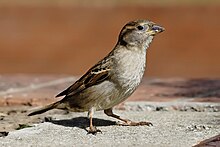
 small bird withpale belly and breast and patterned wing and head stands on concrete
                           The range of the House Sparrow has expanded 
                                dramatically due to human activities.


Birds live and breed in most terrestrial habitats and on all seven continents, reaching their southern extreme in the Snow Petrel's breeding colonies up to 440 kilometres (270 mi) inland in Antarctica. The highest bird diversity occurs in tropical regions. It was earlier thought that this high diversity was the result of higher speciation rates in the tropics, however recent studies found higher speciation rates in the high latitudes that were offset by greater extinction rates than in the tropics. Several families of birds have adapted to life both on the world's oceans and in them, with some seabird species coming ashore only to breed and some penguins have been recorded diving up to 300 metres (980 ft).

Many bird species have established breeding populations in areas to which they have been introduced by humans. Some of these introductions have been deliberate; the Ring-necked Pheasant, for example, has been introduced around the world as a game bird. Others have been accidental, such as the establishment of wild Monk Parakeets in several North American cities after their escape from captivity. Some species, including Cattle Egret,Yellow-headed Caracara and Galah, have spread naturally far beyond their original ranges as agricultural practices created suitable new habitat.

Diversification of modern birds


Diversification of modern birds

Containing all modern birds, the subclass Neornithes is, due to the discovery of Vegavis, now known to have evolved into some basic lineages by the end of the Cretaceous and is split into two superorders, the Palaeognathae and Neognathae. The paleognaths include the tinamous of Central and South America and the ratites. The basal divergence from the remaining Neognathes was that of the Galloanserae, the superorder containing the Anseriformes (ducks, geese, swans and screamers) and the Galliformes (the pheasants, grouse, and their allies, together with the mound builders and the guans and their allies). The dates for the splits are much debated by scientists. The Neornithes are agreed to have evolved in the Cretaceous, and the split between the Galloanseri from other Neognathes occurred before the Cretaceous–Paleogene extinction event, but there are different opinions about whether the radiation of the remaining Neognathes occurred before or after the extinction of the other dinosaurs. This disagreement is in part caused by a divergence in the evidence; molecular dating suggests a Cretaceous radiation, while fossil evidence supports a Tertiary radiation. Attempts to reconcile the molecular and fossil evidence have proved controversial.

The classification of birds is a contentious issue. Sibley and Ahlquist's Phylogeny and Classification of Birds (1990) is a landmark work on the classification of birds, although it is frequently debated and constantly revised. Most evidence seems to suggest the assignment of orders is accurate,but scientists disagree about the relationships between the orders themselves; evidence from modern bird anatomy, fossils and DNA have all been brought to bear on the problem, but no strong consensus has emerged. More recently, new fossil and molecular evidence is providing an increasingly clear picture of the evolution of modern bird orders.